
As many of you know, I love to paddle in my kayak and/or canoe, mostly recreationally and on flat water. If there is any one factor, in my experience, that affects how I enjoy the paddle, it is wind speed. In fact, normally I would avoid getting out on the water if wind speeds are gusting over 20 km/h.
This past Spring and Summer I have not been able to get out as often as I usually do. My extra course work has kept me busy during any free time I have.
So, during the latter part of my vacation at the end of August when there was correspondingly a break between semesters, I took full advantage and resolved to get out in my kayak as often as possible.
I was hoping for calm winds and sunny skies, of course.
But when Jessica and I arrived at our riverside camp site on the first day of our camping trip, it was sunny but, oh, it was gusting something fierce. I looked out over the bay in the Ottawa River and noticed the slightly cresting whitecaps. Borderline. But, it was my first opportunity to get out on the water all summer long. How could I not?
With hat strapped securely on my head and uncertainty and fear swirling in my gut, I launched my kayak into the choppy waters and headlong into the stiff breeze. Prayers for safety and confession of fear accompanied me on my way into the water. But I was also curious to test my abilities that had lay dormant for a year.
Wind and Spirit are the same word in both Hebrew – the language of the Old/First Testament – and Greek – the original language of the New Testament (Lutherans Connect, 2024). So, what went through my mind as I tumbled into my tiny vessel was that there surely must be something I can learn from being vulnerable to the wind. What could the wind teach me about the Spirit of God?
There are other places in the world where the winds blow constantly and at fierce velocities. Slope Point, on the southernmost tip of New Zealand, is a rocky shoreline made almost inhabitable by high-powered winds, having soared some 3200 kms across the Antarctic Ocean uninterrupted (Lutherans Connect, 2024). The winds are so strong it is possible to become almost airborne when you lean into it and jump.
The wind, of course, can be dangerous for its unpredictability, uncontrollability and its destructive potential. That, too, went through my mind as I struggled to keep my kayak upright and moving in tandem with wave and wind. I wisely decided not to push it and cross the river to the other side that first time out. Rather, I stayed in the relative safety of the bay. I was getting the hang of it by focusing on my paddling and keeping an even and steady stroke going.
In the Gospel reading today (Mark 8:27-38), we witness an identity crisis that those who follow Jesus appear to be having. They can’t seem to understand who Jesus is. At best, they skirt around the edges of truth and express different perceptions: Some say John the Baptist, some say Elijah, others, one of the prophets. Who is this Jesus? Peter says, the Messiah.
However, Peter has become accustomed to thinking the Messiah as a wonder-worker with the power to banish every difficulty and suffering (Shaia, 2021). Peter has come to expect Jesus to be a miracle-working Messiah.
In contrast, Jesus’ response is firm in describing God who embraces the path of great trial, conflict and loss. Disciples of Jesus will, consequently, not minimize, evade or divert from the hard realities of life. Jesus tells Peter, in other words, that if he is only looking for a “super-parental divine rescuer” (Shaia, 2021, p. 158), then he has not yet understood the nature of his faith.
God is certainly capable of rescuing us. But God will not always rescue us. Because God has faith in us. God gave us resources and gifts to use and employ. God allows us to use our abilities and capacities including our supports and others for help so we will mature and grow in faith.
Peter is just one example from the bible. There are many others. Read the stories of David from the books of Samuel in the First Testament. David had been chosen as a child already. Yet God did not intervene every time in his life to keep him from making mistakes or taking the occasional wrong turn. God did not rescue him, because God wanted him to mature.
Part of the maturity process, apart from learning from past mistakes, is realizing with joy and thanksgiving the resources, capacities and gifts we have that may have gone unrecognized when the proverbial waters of our lives were once calm and still.
Up until my kayak experience that windy day on the Ottawa River, I had never had a wave actually wash over the deck of my kayak and into the cockpit. I had assumed that if that ever happened, I would be in serious trouble, at risk of capsizing and swamping the boat.
I was wrong.
On that day a large wave struck the side of my boat. While the surge of river water soaked my pants, my little craft stayed true when I just kept my arms moving and paddling through it – left, right, left, right ….
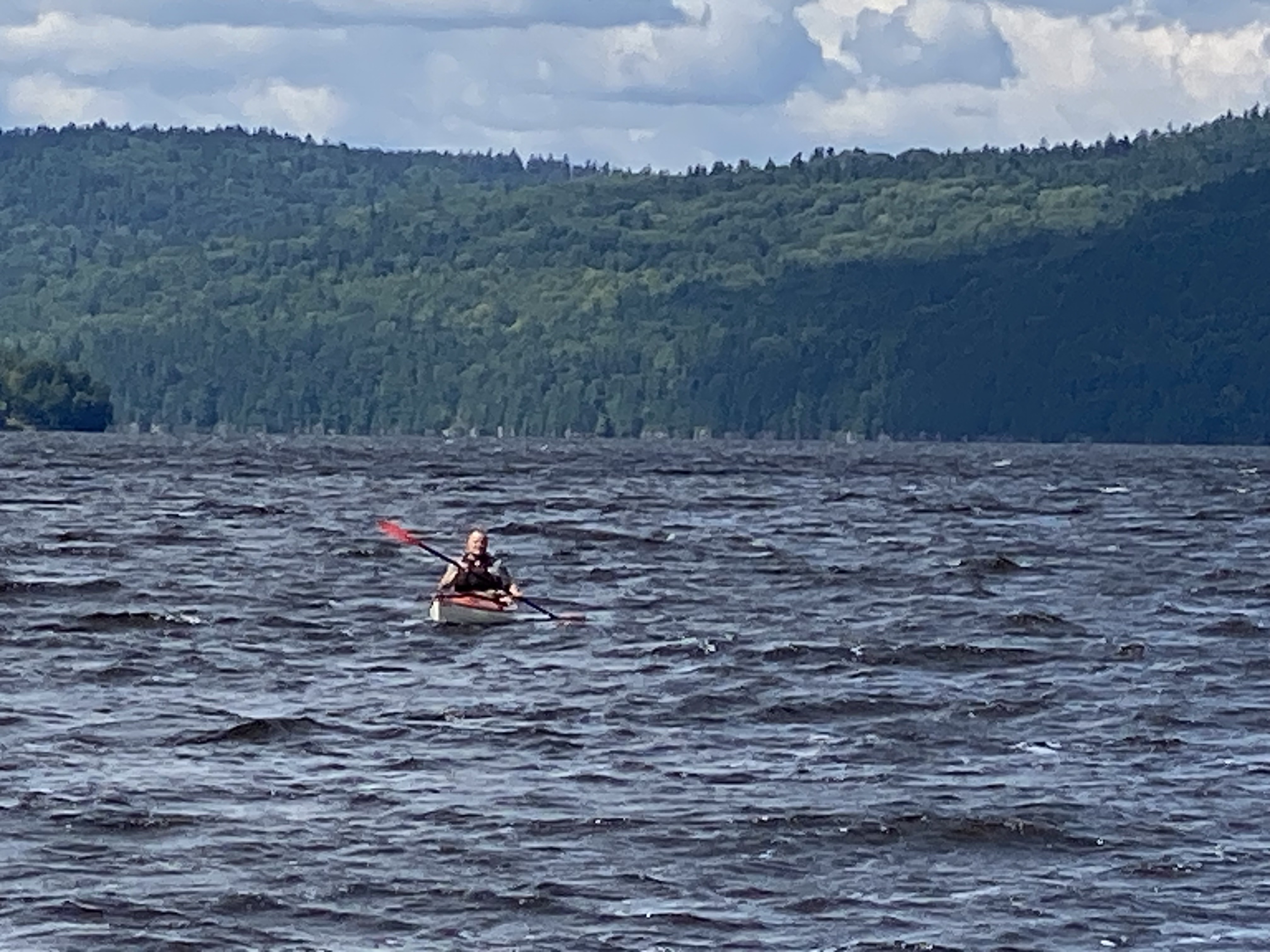
August 21, 2024 (photo by Jessica Hawley Malina)
Then I thought of the design of my craft, built near Algonquin Park for these very waters – a stable, wide hull with a skeg, like a rudder, which I could deploy in deeper waters to keep my tracking straight when current and wind assailed me. I had my life jacket on. It was all good! And I was having a blast! I had underestimated my capacities and resources.
Following Jesus is as if we were in a tiny boat on a menacing sea in a great storm. The storm overwhelms our senses. Emotionally we feel completely directionless. What shall we do?
We have only two helpful choices: We can perform the one simple task we have – we can row: left, right, left, right … keep going. And not give up.
And we can pray. Our prayer is first one of surrender. We surrender our previous evasion, avoidance, assumptions and denial tactics when we realize they are not particularly helpful nor relevant in the present circumstances.
Our prayer is then one of trust with full awareness and acceptance of the path ahead. We trust that the journey is long and full. To believe the journey is long and full, I mean that amidst the storms we all face there will be a time when the waters will be still again, and the breeze soft and calm.
A few days later, I indeed experienced the glory, peace and brightness of a paddle in the river when the water was as still as glass. I stayed out for hours. And I thanked God.
References:
Lutherans Connect. (2024, September 9). On the threshold. Centre for Spirituality and Media at Martin Luther University College. https://lconthethreshold.blogspot.com
Shaia, A. J. (2021). Heart and mind: The four-gospel journey for radical transformation (3rd ed). Quadratos.
 Raspberryman