
[Jesus said] “My Father has a great love for me, for I lay my life down to take it back again. No one takes my life from me, for I lay it down on my own. I have the right to lay my life down and the right to take it back. It is my Father who gives me this right” (John 10:17-18; First Nations Version, 2021).
The Ottawa Lutherans online book club just finished reading about going on a pilgrimage. Specifically we read Tim Moore’s book about his pilgrimage to Santiago (Moore, 2004).
But what sets his book apart from all the other Camino books is that Tim Moore completed the 800-kilometre trek with a donkey, named Shinto. The entertaining account centres on this relationship between man and donkey, and their many adventures.
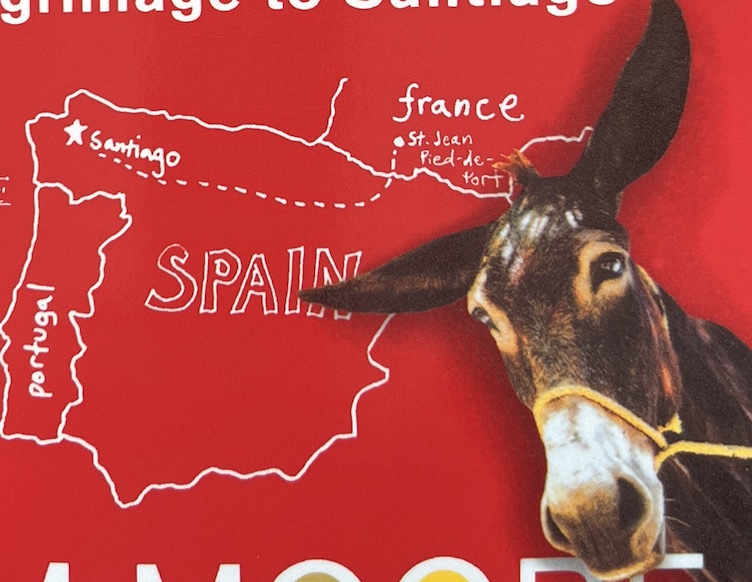
Shinto was by far my favourite character even though, of course, he doesn’t say a word. Shinto’s intentions, aversions, foibles and reactions are all revealed by his behaviour and physical expression.
If you have walked the Camino de Santiago, you may recall the many bridges you crossed on this journey through northern Spain, from narrow foot bridges over shallow streams to large, urban multi-lane highway bridges spanning major rivers.
But one thing Shinto would never, ever do is walk over any body of water. He would just dead stop right before the bridge and there was very little anything Tim could do to goad, force, shoo, push, haul that beast across. Shinto won that argument most of the time. And so, for much of the Camino, Tim would have to lead Shinto the long way around in order to avoid crossing those bridges.
As you can imagine, it was the source of major friction between the two of them. Shinto’s stubbornness caused Tim so much exhaustion and frustration.
Nearing the end of the Camino, Tim was joined by his family for a few days, including his young daughter, Lilja. Tim Moore describes a moment when the three of them approached the next bridge:
“…There was a bridge over an irrigation culvert, a sheet of galvanized metal which sang like a saw when I planted a boot on it. This sensory experience had a predictable effect on Shinto, and with a sag of the shoulders I turned around.
“’What are you doing?’ asked Lilja.
“’We’re going back to find another way,’ I said, lightly massaging a tender spot on my right temple, and at this stage of the day I had no wish to expose my daughter to scenes incorporating adult language and strong graphic horror.
“As I’d seen so many others do, she grimaced sceptically at first donkey, then bridge. ‘But it’s really small.’ I nodded vacantly, then set about wheeling Shinto round. ‘Have you tried holding out some of his favourite stuff from the other side?’
“’I’ve tried everything.’
“She twisted out a frond of alfalfa from the pathside. ‘Can I try again?’
“I suppressed a sigh. ’Quickly, then.’
“Lilja looked at Shinto in mock reproach, one hand on hip and the other proffering the vegetable lure. Then she leant forward, and whispered, ‘Now, Shinty, it’s only a little bridge.’ His ears shot up and without hesitation or deviation he clanged straight over” (p. 229-230).
Tim Moore doesn’t explain his daughter’s gift of having that special connection with Shinto, apart from observing Lilja successfully do “her donkey-whisperer thing” (p. 234) for a few more days on the Camino.
And I don’t know why I thought of Shinto when reading the perennial Gospel text for this fourth Sunday of Easter. Today is traditionally called Shepherd’s Sunday. Jesus is the good shepherd. I think of the metaphors describing Jesus’ relationship with us in terms of animals, and sheep no less. What’s about those sheep, and what’s about God who knows how to relate to us?
Maybe the sheep in the gospels are there to remind us that we cannot control matters of faith in our relations—divine, human and non-human. And maybe that’s the point. We cannot force the issue, make others do things we are convinced are right. There is something here beyond our capacity to manage and control. And that’s what makes our faith journeys, individually and in community, such a challenge and such a joy!
Because love begins in freedom. Love is not love unless it starts in freedom. Jesus “lays down” his life and “takes it up again” of his own volition, his own freedom. This is the basis of the Father’s love for him.
Jesus “lays down” his life for the sheep. When you can’t force, control or manage outcomes, you’re giving up without giving up. You have to, like many beasts of the field, “center down” and trust God.
How do we do that? Jesus says that the sheep “will know my voice”. There was something about Lilja’s manner and the sound of her voice that convinced Shinto to cross the bridge. Shinto’s ears are a prominent feature in Tim Moore’s descriptions throughout the book. Listening for the deeper truth, the deeper reality. And trusting in it.
A story is told about Howard Thurman—20th century American author, Christian mystic, civil rights leader and theologian. “As a seminary student walking home late one night, Howard Thurman noticed the sound of water. He had taken this route many times, and he had never heard even a drip.
“The next day Thurman discussed his observations with one of his professors, who told him that a canal ran underneath the street. Because the noises of streetcars, automobiles, and passersby were absent late at night, Howard could discern the sound of water.”
Later, “Thurman equates these sounds … to the inner chatter within our minds that prevents us from being aware of God’s presence. Quieting the surface noise in our minds is what Thurman urges us to do when he instructs us … to ‘center down’” (Coleman Brown, 2023, pp. 121-123).
For most of our wanderings in life, we are probably not aware of what is underneath us and how deep it goes. We can’t hear it. And when we’re faced with challenges in life, meet obstacles on the journey of faith, and we begin to sense what we’re walking over, maybe like Shinto we need to stop.
But here’s the crux of the matter, potentially the turning point of our lives. We don’t need to stay frozen in place. And we don’t always have to turn around and go backwards. In that moment of uncertainty, we can “center down” and listen. Listen to her voice, the whispering voice of God’s Spirit reaching deep into our hearts, to urge us forward in faith.
We wonder today how to witness our faith, how to relate in faith to our children and grandchildren. Maybe we need to be reminded again that Jesus doesn’t force us to do anything. Because God loves us and gives us the freedom and the responsibility to respond however we will. Following God does not come from willfulness but from listening (Palmer, 1999, p. 4).
And we, in turn, don’t will ourselves or will others into ways of being. Our task is first to listen. And trust in the ever-present movement of God’s Spirit flowing through, underneath and all around all our relations. Amen.
References:
Coleman Brown, L. (2023). What makes you come alive: A spiritual walk with Howard Thurman. Broadleaf Books.
First Nations version: An Indigenous translation of the New Testament. (2021). InterVarsity Press.
Moore, T. (2004). Travels with my donkey: One man and his ass on a pilgrimage to Santiago. St. Martin’s Press.
Palmer, P. (1999). Let your life speak: Listening for the voice of vocation. Jossey-Bass.
 Raspberryman