
22They were astounded at his teaching, for he taught them as one having authority … 27They were all amazed, and they kept on asking one another, “What is this? A new teaching—with authority! He commands even the unclean spirits, and they obey him.”[1]
Our focus may understandably shift, right away, to the extraordinary healing of the man with an unclean spirit in the synagogue. It’s a dramatic scene that catches our attention.
But, in this season after Epiphany when we look again at God’s revelation in Jesus, it is worth our while to put the spotlight on Jesus. What’s with him? And why would we listen to what he has to say in the first place, this son of a carpenter from Nazareth? Is there something more to him?
The word ‘authority’ is mentioned twice in this short Gospel text, coupled with a similar word, ‘command’. Why and how does Jesus command others and speak with authority? What can we learn from the way Jesus exercises his authority?
A good starting place is to reflect on our understanding and practice. How do we exercise authority? How do you?
When I want to speak with authority, I catch myself often referring to someone else—an authority on the subject matter. I will quote so-and-so, say that someone else said this-or-that. I will cite scripture, or scientific studies that are peer-reviewed and published in academic journals. I’ll refer to the owner’s manual to justify my saying anything “with authority” to someone else.
So, the first thing I notice about how Jesus exercises his authority is he doesn’t defer to anyone else. He speaks from his own “I”- place. He doesn’t shift authority to outside himself. He is God, after all. We wouldn’t expect God Almighty to do otherwise.
And yet, examples abound throughout scriptures of humans who spoke with God’s authority. Besides Jesus, or God, who in the bible can you think of, who spoke with authority? What role did they play? Here’s a hint, of someone from our own era – the picture is posted here … Some have called Martin Luther King a modern day prophet.
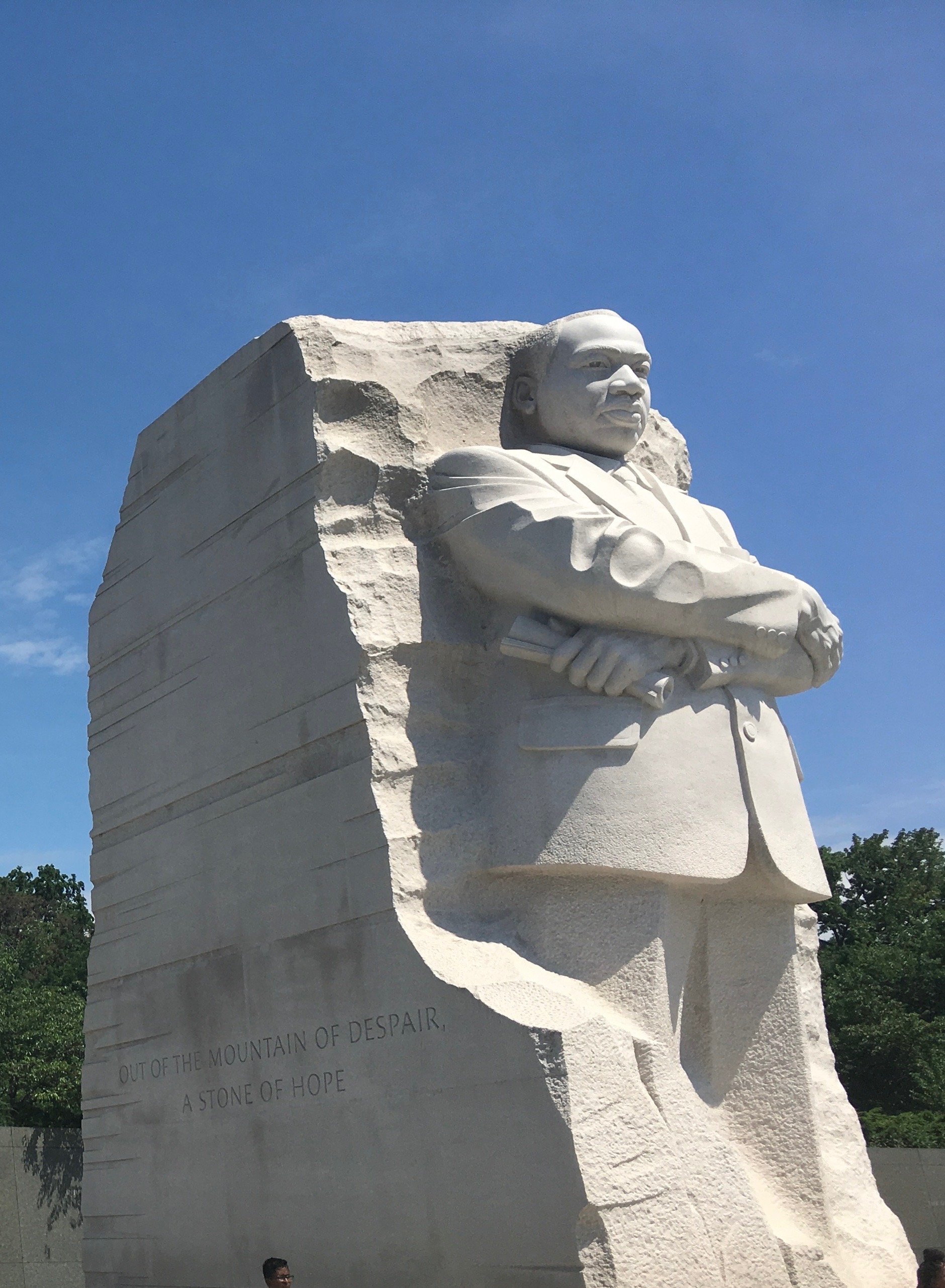
Of course, we know the prophets from the First Testament. The prophets spoke God’s word that, yes, was given to them.
But the message they received was curated in their own hearts and expressed through their own unique voice. They may have resisted initially, as did Moses[2], Isaiah[3] and Jeremiah[4]. But in the end, they exercised their God-given authority to speak and to act. In the end, they accepted the call of God to exercise authority based on conviction born in their own hearts.
It’s important to say here that we’re not talking about ‘opinion’. Opinion arises from our heads, our minds which are constantly churning. Speaking with authority is not shooting off opinions about this, that, or the next thing as if we are in some gunfight at the O.K. Corral.
Speaking with authority comes from the heart and experience with tested knowledge. And that’s what makes it more challenging. It’s taking responsibility and acting on a deep conviction of what is right.
Exercising God-given authority comes from recognizing that God gave us brains and voices and bodies and resources to use for God’s purposes. Exercising God-given authority comes from owning the ability we have, to choose what we think and believe, and the power to act on it. That’s on us.
We are not all called to be prophets per se. But we are called to follow Jesus in his way. Our task is to discover our own voice to speak God’s truth in our lives and in our world.
This quest is not an easy one, to learn how to trust the goodness of God in Christ Jesus within you. It’s work to practice accepting the gift of God’s presence in your own life. It’s a lifetime journey.
Listen to this Indigenous legend written by the late Canadian author Richard Wagamese. He writes of the Creator God calling a great meeting of the Animal People. “In those days … [the animals] shared the earth and its riches without conflict. There was harmony and there was peace.
“The Creator said, ’I am going to send a strange new creature to live among you.’” The Creator went on to describe the humans who will be “born without fur or feathers on his body”, who will “walk on two legs and speak a strange language.”
The humans will come into the world bearing a marvelous gift, “the ability to dream”. And because of this ability to dream they will “create many wonderful things.” But their inventions will keep them separate and they will lose their way. ’So,’ said the Creator, ‘I am going to give them a second marvelous gift. I am going to give them the gift of Knowledge and of Truth.’
“’But I want them to have to search for it. Because if they find it too easily, they would take it for granted. So, I need your help. No one knows the world better than you, and I need to know where to hide this gift. Where to place it so humans must search long and hard for Knowledge and Truth. Some place where it will not be an easy search.’
“The Animal People were surprised and honored by the Creator’s request. They were thrilled to hear of the arrival of a new creature …and they were anxious to be the humans’ teachers and to help the Creator find a place to hide the gift of Knowledge and of Truth.
“’Give it to me, My Creator,’ said the Buffalo, ‘and I will put it on my hump and carry it to the very middle of the great plains and bury it there.’
“’That’s a very good idea,’ the Creator said, ‘but it is destined that humans shall visit every place on earth, and they would find it there too easily and take it for granted.’
“’Then give it to me,’ said the Otter, ‘and I will carry it in my mouth and place it at the bottom of the deepest ocean.’
“’Another good idea,’ the Creator said, ‘but with their ability to dream, humans will invent a wonderful machine that will take them even to the depths of the ocean and they will find it too easily and take it for granted.’
“’Then I will take it,’ said the Eagle, ‘and I will carry it in my talons and place it on the very face of the moon.’
“’No’, said the Creator, ‘that is an excellent idea too, but part of human destiny will see them reach even to the moon and they would find it there too easily and take it for granted.’
“One by one the Animal People came forward and offered suggestions on where the Creator could hide the gift of Knowledge and of Truth. One by one the suggestions were turned down. It began to look like they could never find a suitable place.
“Finally, a small voice called from the very back of their circle. All eyes turned to see a tiny mole, a tiny, half-blind mole asking to speak.
“Now, the mole was a very respected member of the Animal People. The mole lived within the earth and so was always in contact with Mother Earth. Because of this the mole possessed great wisdom. And because he had lost the use of his eyes the mole had developed true spiritual insight …
“’I know where to hide it,’ the Mole said, ‘I know where to place this great gift of Knowledge and of Truth.’
“’Where then?’ the Creator asked. ‘Where should I hide this gift?’
“’Put it inside them,’ the Mole said with great dignity. ‘Put it inside them. For then only the bravest and purest of heart will have the courage and the insight to look there.’
“And that is where the Creator placed the gift of Knowledge and of Truth. Inside us.”[5] Do we dare to look there?
In closing, let us pray, using these words of Saint Paul, writing to the Ephesians: “To God who by the power at work within us is able to accomplish abundantly far more than all we can ask or imagine, to God be glory in the church and in Christ Jesus to all generations, forever and ever. Amen.”[6]
[1] Mark 1:21-28, the Gospel reading for the Fourth Sunday after Epiphany, Year B (RCL).
[2] Exodus 3:11
[3] Isaiah 6:5
[4] Jeremiah 1:6
[5] Adapted from Richard Wagamese. (2019). A Quality of Light: A Novel, 261-264. Anchor Canada.
[6] Ephesians 3:20-21
 Raspberryman