
It’s been hardly two weeks since Christmas Day. It feels like Christmas is already over before it even began. Our culture, and the church, have both conspired to make short shrift of the season.
It’s more obvious in our culture: How many of us already took down the Christmas decorations on Boxing Day? But, the church, too: The liturgical calendar finds us barely twelve days since the first day of Christmas, and Jesus is already being baptized today on this “Baptism of our Lord” Sunday. In a compressed schedule this year, Jesus goes from infant lowly to thirty years old, in fourteen days.
You may argue that is the case because scripture doesn’t have much to say about the birth narrative—a mere four chapters total in Matthew and Luke. There is precious little from Jesus’ life until he appears at his baptism.[1]
But the bottom line is that we spend very little time in the year reflecting solely on the meaning of Jesus’ birth. And it took a long time in history before Christmas even appeared on the liturgical map, so to speak.
Until the 12th century, Easter was by far the major, annual Christian celebration. Then, in the 13th century Saint Francis of Assisi popularized the Christmas message of the Gospel. Since then, Christmas became a more dominant annual festival.
Francis emphasized the Incarnation, in which we celebrate God taking human form in the birth of Jesus. By the blending of lights in the branches of a Christmas tree, Martin Luther emphasized what Francis did a few centuries before him: He saw a beautiful coming together of the divine and earthly—which is, after all, the Christmas and Christian message.
Echoing the oft repeated word in the story of creation[2] – that everything God created was good to begin with, Christmas does a similar thing. The Incarnation means: “It is good to be on this Earth, it’s good to have a body, it’s good to have emotions. We don’t have to be ashamed of any of it! God loves matter and physicality.”[3]
As Saint Paul testifies, the Holy Spirit of God comes into us—our very selves—and enlightens our lives so we can shine the love of God in this bleak world.[4] That says a lot about this God whom we follow.
Jesus immersed himself in the physicality of our lives. He was a real person. He submerged himself in the waters of creation when he was baptized. He got his feet dirty with the dust from the roads in the Judean wilderness. Unlike other rabbis and religious leaders, Jesus lived and taught mostly outside, in the natural world. He hung out with the rebel, John the Baptist who also spent a lot of time in the wilderness.[5]
One of the gifts I received this Christmas was this 1000-piece puzzle of the classical nativity scene. And it made me think of all the nativity sets I have at home. And not one that I have allows you to separate the baby Jesus from his manger; they all have Jesus attached to his crib.
Let me suggest a nativity set that allows you to take the infant out of the manger. Do you have one that lets you take Jesus out of the set, like the one we have here at church where you can leave empty the manger of Bethlehem? That’s because our spiritual aim in the coming year is to carry the infant with us—actually or in our hearts—wherever we go.
And that’s the message of Christmas, and of the Incarnation: Christ is with us and goes wherever we go in our daily, common lives. Our work is to build awareness of that truth, so that we can be caught by the realization and message of the incarnation, not only for a couple short weeks at the end of December but year-round.
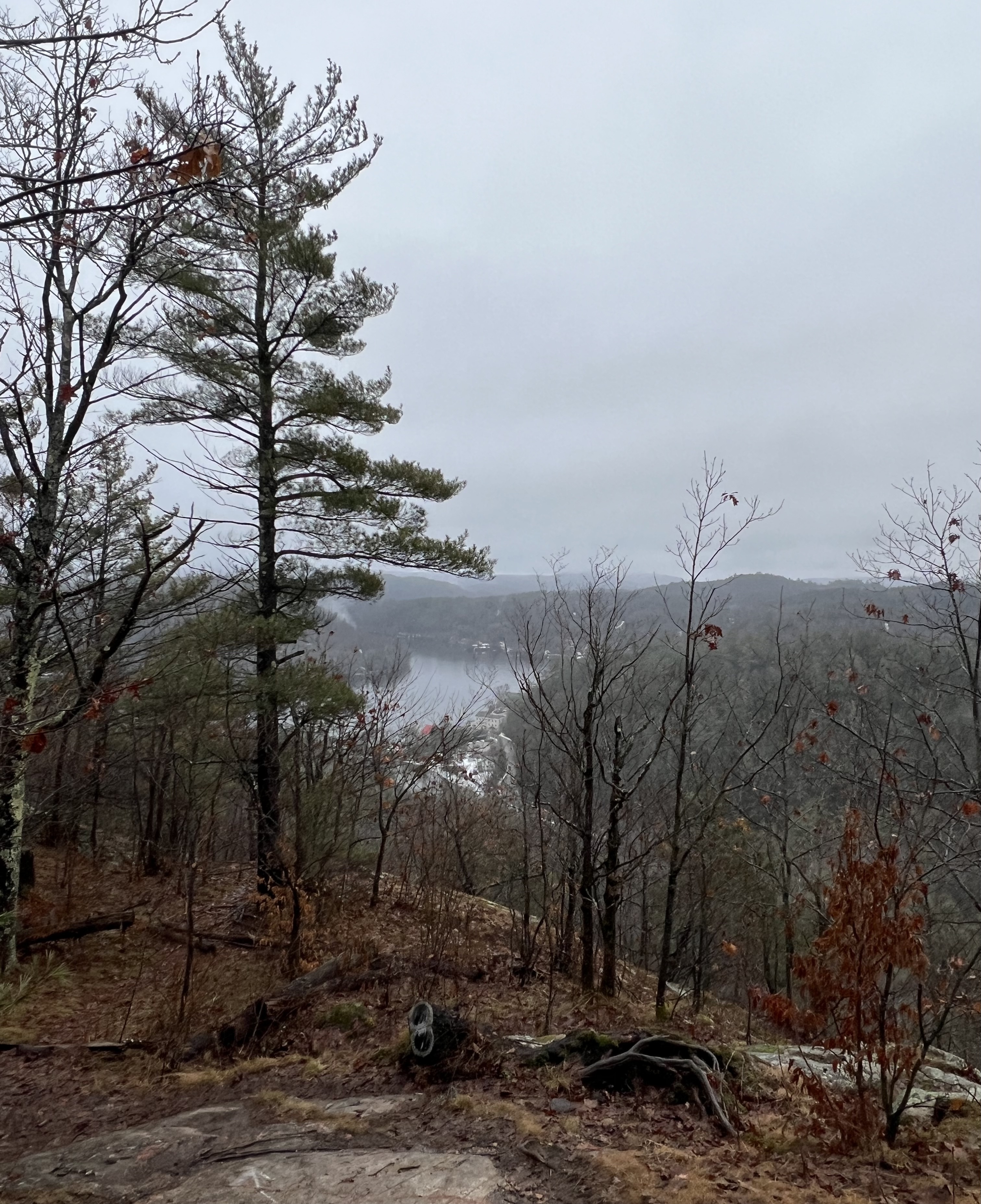
I went for a hike by myself in the Gatineau Park hills near Wakefield, Quebec, last week. It was more of a challenging trek than I had anticipated. Yes, there was little snow on the ground and temperatures were hovering above the freezing mark. So, the conditions weren’t the typical wintery ones that would have introduced other challenges.
You see, I had to keep focused on the ground in front of me for each step I took. My head was down. The trail had me scrambling over boulders that were wet and some were glossed over with packed, melting ice; leaves covered some of these patches of ice.
If I wasn’t careful coming down the hill at full speed, I could put my full weight on one of those clumps of leaves and fall badly.
I also had to check my phone periodically to make sure I stayed on the path and not get lost in the waning light of the late afternoon. My attention was thus divided, and I didn’t always maintain my balance. It was dangerous, yet invigorating.
As I took another tentative step over a rock face on the side of the hill, my peripheral vision caught a large, low flying object that swooped down in front of me. And then, it launched high into the crook of a large tree several metres into the bush.
My eyes shot up. I could see the back side of this large, feathered friend. It was beige with white streaks and spots. I was waiting for it to turn around and face me so I could identify it more easily. Was it a Barred Owl? But it didn’t turn around. It kept its face hidden from me. It didn’t want to be directly seen.
Curious, I acknowledged the owl had initiated contact in the first place. It caught my attention. After all, it didn’t need to fly so low in front of me, across the path just ahead of me a few paces. It wanted me to see it.
I took a moment to look up around me. It was a beautiful forest I was hiking through. All was still. All was calm. The fog was moving in, silently. The trees were densely thick, but I could just make out the town far below, seeing between the trunks of the leafless trees. The ground beneath my feet was a rich auburn colour of the dead leaves and needles scattered over the exposed igneous rock and stretches of loamy soil.
I think Jesus catches our attention, too. Especially when our vision tends to narrow, and we become fixated on the ground in front of us. When we focus on the immediate, and what concerns us, when we get wrapped up in our heads too long. Not bad things. But not everything.
At those times our heads are weighed down by all our concerns and routines, we may be surprised by grace. A flutter of wings just beyond the limits of our perception. Something happens, often beyond our control, that causes us to look up, look around, and look far down the path. Get the big picture.
Sometimes in our daily living, we just have to stop what we are doing and look up. Breathe. And enjoy the surprise, the moment, the reminder that we are not alone on this journey. The divine may be just out of our reach but never far away. Should we take the moment and simply behold.
I was enjoying myself on the walk. I didn’t need to see that owl if it didn’t catch my attention, or I missed it somehow. The experience of being outside and in the bush was enough for me to find my rest and exercise and activity. Moving outside felt good!
But that encounter with the owl added something so much more to the experience. That moment gave me the faith to believe that I would be ok, the rest of the way down the hill. In that moment, my heart opened, and my vision expanded. I felt, life is good. And I felt hopeful.
I am grateful for moments throughout the year in all manner of places and people where and when Christ will surprise me with divine reminders of his presence in my life. I hope the same for you in 2024.
[1] See the first two chapters in Matthew and Luke. The Gospel of Mark makes no mention of Jesus’ birth, and opens his gospel with Jesus’ baptism by John, in Mark 1:4-11.
[2] Genesis 1:1-5
[3] Richard Rohr, “Celebrating Incarnation” (Daily Meditations, www.cac.org, 18 Dec 2023)
[4] Acts 19:1-7
[5] Consider where John the Baptist was baptizing. His ritual of repentance took place at the Jordan River, just east of the city of Jericho. Where John baptized was precisely where the Hebrews had crossed into the Promised Land centuries before. John the Baptist stood at the Jordan’s ancient crossing place and points in the direction from which the Hebrews originally came: the wilderness. John the Baptist cries out, “Repent!” and calls for a commitment to go back into the wilderness of their lives, to make radical change and correction. The root of the word, “repentance” is the Greek word poina which means “pain”. Historically, one of the linguistic forks this word took was the meaning of conscience and absolution. In other words, repentance is a correction of one’s heart and mind— “an act of personal, voluntary, inner change” (Alexander John Shaia, Heart and Mind; The Four-Gospel Journey for Radical Transformation. New Mexico: Quadratos LLC, 2021, p.92-93)—which is in a sense a painful process. To repent is to change one’s heart and mind, one’s direction in thinking. That’s not easy. Yet, it is the only way to freedom. The Gospel of Mark invites us to enter the river of our baptism into Christ Jesus and accept a new direction for our lives. Following Jesus will take us into the wilderness, too, where Jesus went immediately after he was baptized, a place of tension, temptation and yes pain (Mark 1:12-13)—growing pains.
 Raspberryman