
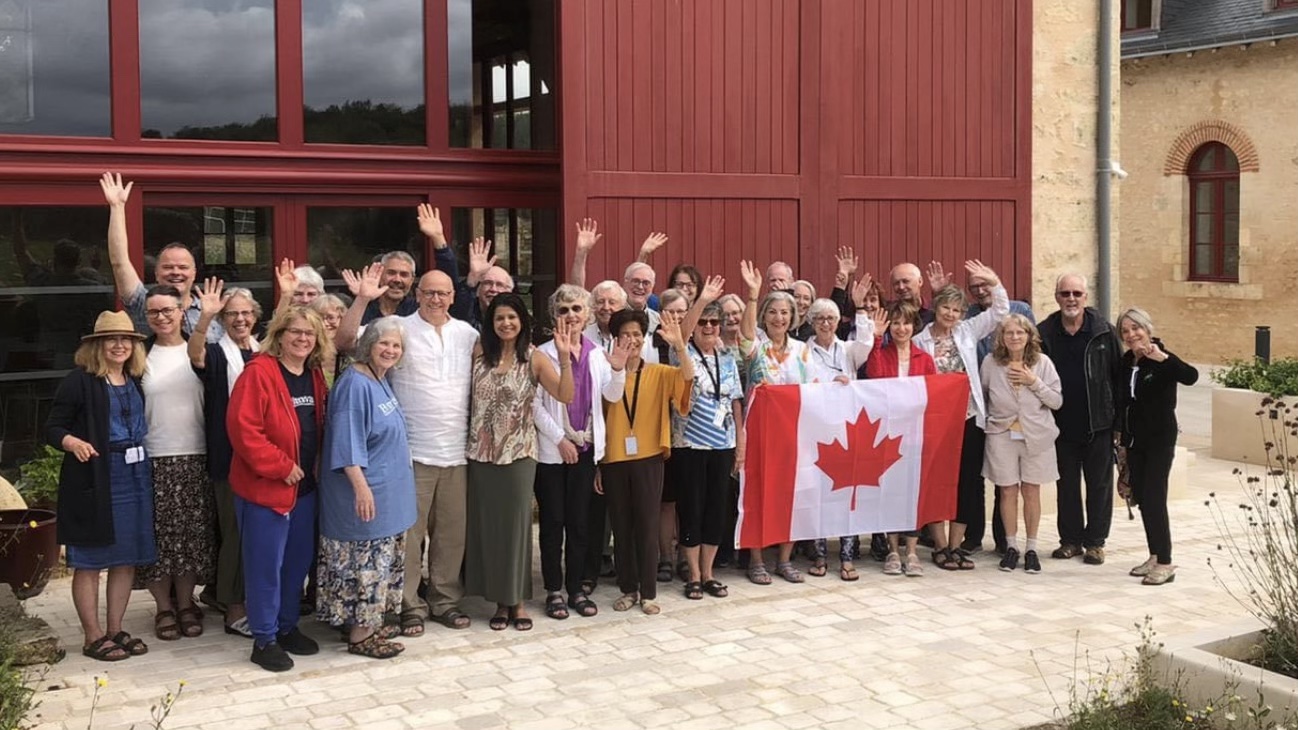
A group of thirty Canadians held a prayer retreat at the Bonnevaux Centre for Peace near Marçay, France, last summer. Of the half dozen people who live there permanently, one of them stood out for me. And to this day I’m still pondering how it is this person’s presence with us made such an impact on me.
Because this person wasn’t the charismatic and articulate leader of the retreat. He didn’t guide us expertly through the sessions. Unlike the other half dozen permanent residents, he didn’t provide AV support for the presentations, nor did he organize us for mealtimes or get us clean towels when we needed them. Neither did he lead in singing the liturgies. He wasn’t extroverted and the type of person keeping us in stitches all the time. He certainly wasn’t ‘the life’ of the party. And his face wasn’t plastered over all the glossy hand-outs promoting the retreat house.
Well, then, you ask, if he wasn’t all these things, who was he, what did he do, and why was he there?
When he was being introduced to us at the beginning of the retreat, I learned that Tomas was an organic farmer who lived in a tiny house on the other side of the forest with his wife. He farmed a small portion of the 160 acres belonging to the Bonnevaux retreat centre. I suspect he provided much of the produce we ate at mealtimes.
But there were only a few times during the week that I actually saw him: And that was whenever the whole community gathered for prayer in ‘the Barn’—a large gathering place and central meeting hall at Bonnevaux.
Wearing his work clothes, Tomas attended the daily prayer times with us, obviously joining us in the midst of a busy workday. I could tell by his dishevelled manner and muddied work boots that he was literally coming directly from working on the fields.
Tomas is a cherished member of this small community, even though his role wasn’t clearly defined. He just showed up to pray. And yet, of all the residents there, his presence at prayer made a lasting impression.
Tomas was there. And he continues to have a good, relationship with the community. After all, he and his wife were married in the ‘Barn’ the year previous.
Just showing up. I remember the advice of a seminary professor who counselled us newbie pastors decades ago: He said that at least 50% of doing something valuable in relationship-building is just showing up. If you show up, without saying or doing anything beyond that, you have already accomplished the most significant part of restoring, healing and even initiating health in a relationship. Because if you don’t show up, there isn’t even a chance something good can come of it.
Mary showed up. Mary and Elizabeth present one of the most beautiful friendships in all of scripture.[1] They are relatives, but you get the feeling their relationship runs deeper.
What does the scripture reveal about the nature of their friendship? The emphasis in Luke lies on qualities such as humble trust and surrender to a greater mission. The emphasis is on their honesty and unabashed joy. There is, to cap it off, Mary’s faithful response to God which begins by sharing the news of the angel with her friend.
In this relationship, there is no mention of any moral worthiness, social position, nor achievement. I don’t get the impression that Mary, nor Elizabeth for that matter, were prepared for their special encounter. There is no performance principle in operation here. They are not there to prove themselves to each other, or show-off their new maternity clothes. They are not in competition with each other. There’s no agenda.
There is just this simple, in-the-moment vulnerable trust, mutual love, admiration, and respect. In their interaction, they listen to each other, and affirm one another. Their minds, bodies and spirits are caught up in the love and joy of the moment.
At Christmas, the relationships and friendships especially within our families—whether good or not so good—are exposed for what they are. And if there is any kind of hardship in those relationships, you feel it.
It’s just that for most of the year, we can avoid certain people in our extended families, and go about our lives. But that’s what makes Christmas challenging for many: Because we are confronted with the question of whether we will show up this time, or not.
Maybe showing up means we will argue politics. Maybe showing up means we will renew old debates that have caused rancor and division in the family. Maybe showing up means more hard feelings. And, therefore, we will not show up.
We don’t know the background story of Mary and Elizabeth’s extended family relationships. It’s safe to assume, like in every family, there were tensions and personalities that clashed.
There is nevertheless something simple and ordinary about what they share in that one moment, that one interaction. The good happens, because Mary just shows up. And, as a result, their hearts become joyful for the gifts they both receive.
And maybe that is why Tomas is important for the community at Bonnevaux. He just shows up to pray. And that’s what we are doing today and every time we gather together, to pray. Simple, ordinary and different lives. Trying to make the best of it. But still, just showing up. Giving it a shot. And, sharing something special.
Nothing spectacular about the scene. Except for the gift of ordinary, simple love. Nothing to boast about. Except for what God is about to do in the hearts of simple, ordinary friendships.
God shows up – comes to us – as Friend for life, a friend who is faithful through it all, who meets us where we are, in the ordinary even unexpected moments.
[1] Read the entire first chapter of Luke to get the whole picture.
 Raspberryman