
For the Lord is our God,
and we are the people of God’s pasture and the sheep of God’s hand. (Psalm 95:7)
Unfortunately, not every one of God’s creatures has a home. In Ottawa alone, there are 12,000 families who are without safe and affordable housing. 12,000 households—not individuals—households. Newcomers to Canada are literally getting off the plane in Ottawa looking to find housing that is not available to them. The Mission downtown is where many of these refugees first end up.
By the Fall of this year, a record 74% of all new intakes at the Mission were newcomers to Canada. And, for the first time in history the shelter system in Ottawa—comprising mainly of the Salvation Army, Shepherds of Good Hope and the Mission—was at full capacity in the summer. The shelters were never before at capacity in the summer when sleeping outdoors is an option. Today, 450 families use the shelter system at a cost to the city of $3000/month for each family. A dire situation is looming this winter when already some 260 people live on the street. An alarming housing crisis is only growing.
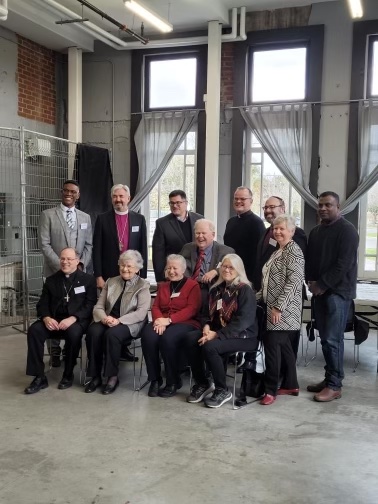
Last Sunday on National Housing Day in Canada, as a patron of Multifaith-Housing-Initiative I attended an event hosted by MHI. Speakers, including Ottawa Mayor, Mark Sutcliffe, mentioned how important it is to work together to help those in need who don’t have a home.
I have a comfortable, safe home to live in. I suspect most of you here and watching at home do. And I ask, as followers of Christ, how do we respond to the needs around us, in light of the Gospel? Do we just focus on helping our own? Is that our mission? What is God’s mission? What does God call us to do?
On the one hand, I believe it matters whom we help.
In the Gospel text for today, Jesus describes the activity of the sheep who are the good guys in this story.[1]
So, it also matters who we are, as followers of Christ.
But what I find curious is that both the sheep—the good guys—and the goats—the bad guys—share the same problem. Both of them ask the King the same question which exposes the failure of their initial perception. “When did we feed, clothe, visit, you?” and “When did we not …?” Both sheep and goats had a break-down in recognizing, being aware, being conscious of doing good, or not doing good.
In the end, it matters what we do, as followers of Christ.
While their perceptive abilities failed all of them, the good news is at least half of them got their activity right. That should indicate what the main gist of this Gospel story is about. Because it’s not ultimately about knowing who’s in and who’s out. It’s not about us making the final judgement about who’s going to heaven and who is going to hell. It’s not about making doctrinal statements about eternity and predestination.
If anything, let’s avoid these red-herring interpretations and extrapolations of the story. Because the main point is not the knowing but the doing. It is feeding the hungry, clothing the naked, visiting the sick and imprisoned regardless of who they are.
One of the attractions of Multi-Faith-Housing Initiative for me is the multi-faith part. Because where religion has been and still is used as a tool for division and war, MHI bears witness in concrete ways to how faith unites people of different religions. Faith is a way of unity rather than division.
On National Housing Day, MHI had to adjust to a last-minute change in venue. That’s because originally, we were going to have the meeting at City Hall, downtown. But because of the weekly Sunday demonstrations about the ongoing war in Palestine clogging up the downtown core, security officials deemed the City Hall area unsafe for us to meet. And so they were going to cancel the event outright.
Fortunately, through some back-room advocacy on MHI’s part, the city was able to provide us with the Horticulture Building at Lansdowne Park instead. For me this was a powerful statement showing our commitment to religious unity, where Jews and Muslims, Protestants and Catholics, Baha’i’s and Hindus, sat shoulder to shoulder in one room to witness to the power of religious unity by participating in a common divine mission to meet a growing need in our city, our province and in our nation. As one of the speakers at the MHI event said, “Never waste a crisis” for the opportunity it creates.
When we want to introduce Christianity to others, especially younger people, sometimes the language of our faith and the words we use are not good starting places. Getting cerebral with definitions of salvation and hell and judgement don’t help as much in witnessing to our faith as it is to do something good together, simply and concretely, to make a positive difference in our world.
It doesn’t matter, who. I think that is the point of the Gospel. There are differences, to be sure, between sheep and goats. But it’s difficult sometimes to tell the difference between sheep and goats, honestly. In the larger scheme of all of creation, those differences are not as great as we often make them out to be.
If we can’t know really who’s in and who’s out, if we fail in our perceptive capability, then perhaps we should leave that part of it alone. Leave the final judgement to God. Judging is not our primary job. Ours is simply to act and help no matter who it is, no matter where they come from, no matter the colour of their skin, the clothes they wear, the language they speak or the creed they follow. It doesn’t matter, who.
In conclusion, let’s turn the clock back to the 13th century. I’d like you to meet Mechthild of Magdeburg, a religious who lived her final years in a monastery of Cistercian nuns. She gradually lost her physical abilities, and this affected her faith. Not only did she go blind and not only could she not do anything for herself, but she felt God’s love had abandoned her. She came to the end of her life in a state of powerlessness which left her feeling bereft of God. A crisis of faith, you might say.
And yet in this state of powerlessness, she rediscovered God in a new way. She began to express deep gratitude for the nuns and the way they cared for her. She began to understand that the way they cared for her was the way she experienced God’s love for her, in her powerlessness.
And she talked to God, that though she had lost her pride in possession of things, “You now clothe and feed me through the goodness of others.” Though she was blind, she prayed, “You serve me through the eyes of others.” Though she had lost the strength of her hands and the strength of her heart, she prayed, “You now serve me with the hands and hearts of others”.[2]
Maybe in seasons of our lives when we experience our own powerlessness, our own weakness and are open to others with our own vulnerabilities and needs, therein lies the way to finding God’s presence, God’s love and God’s power: serving another’s needs, receiving another’s care. And whether we are the one serving, or the one receiving the help, both experience a divine connection.
In the end, it doesn’t matter who. In the end, it is the quality of the relationship that grows and endures: The relationship between people, our relationship with the world and all that is, including the tensions in between—that is what is important in living our faith.
Could it be that in relationships of trust and loving action, it can all belong? And nothing and no one is lost? Indeed,
The Lord is our God,
and we are the people of God’s pasture and the sheep of God’s hand. (Psalm 95:7)
[1] Matthew 25:31-46
[2] Cited in James Finley, “Unraveled by Love” (Richard Rohr’s Daily Meditation: www.cac.org) 27 October 2023.
 Raspberryman