
I had to experience it for my own.
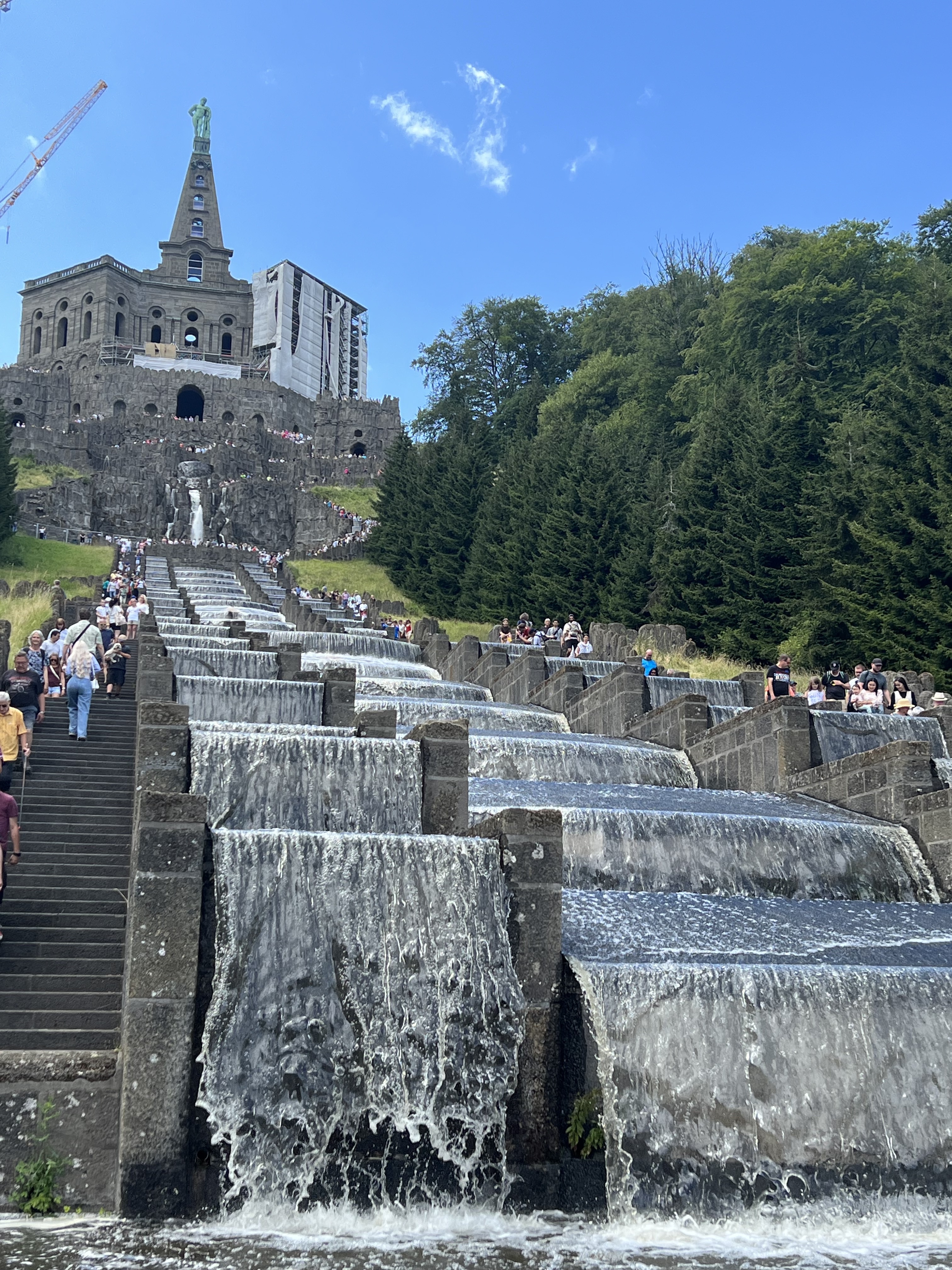
And that meant a rather long, not unenjoyable but challenging, hike up and down a tall mountain and tower in Kassel, Germany, on a sunny, hot day last month. This mountain park called “Wilhelmshöhe” covers an area of over 560 hectares. As such it is the largest of its kind in Europe.[1]
At first, up. We had to get to the top before the water started flowing so we could witness its spectacle. Years ago, I had visited the mountain, saw it from a distance, but for various reasons didn’t ‘experience’ the wonder of its water works.
You see, behind the Hercules monument atop the mountain lies a vast matrix of reservoirs and channels which supply water to mostly underground cataracts and chutes.
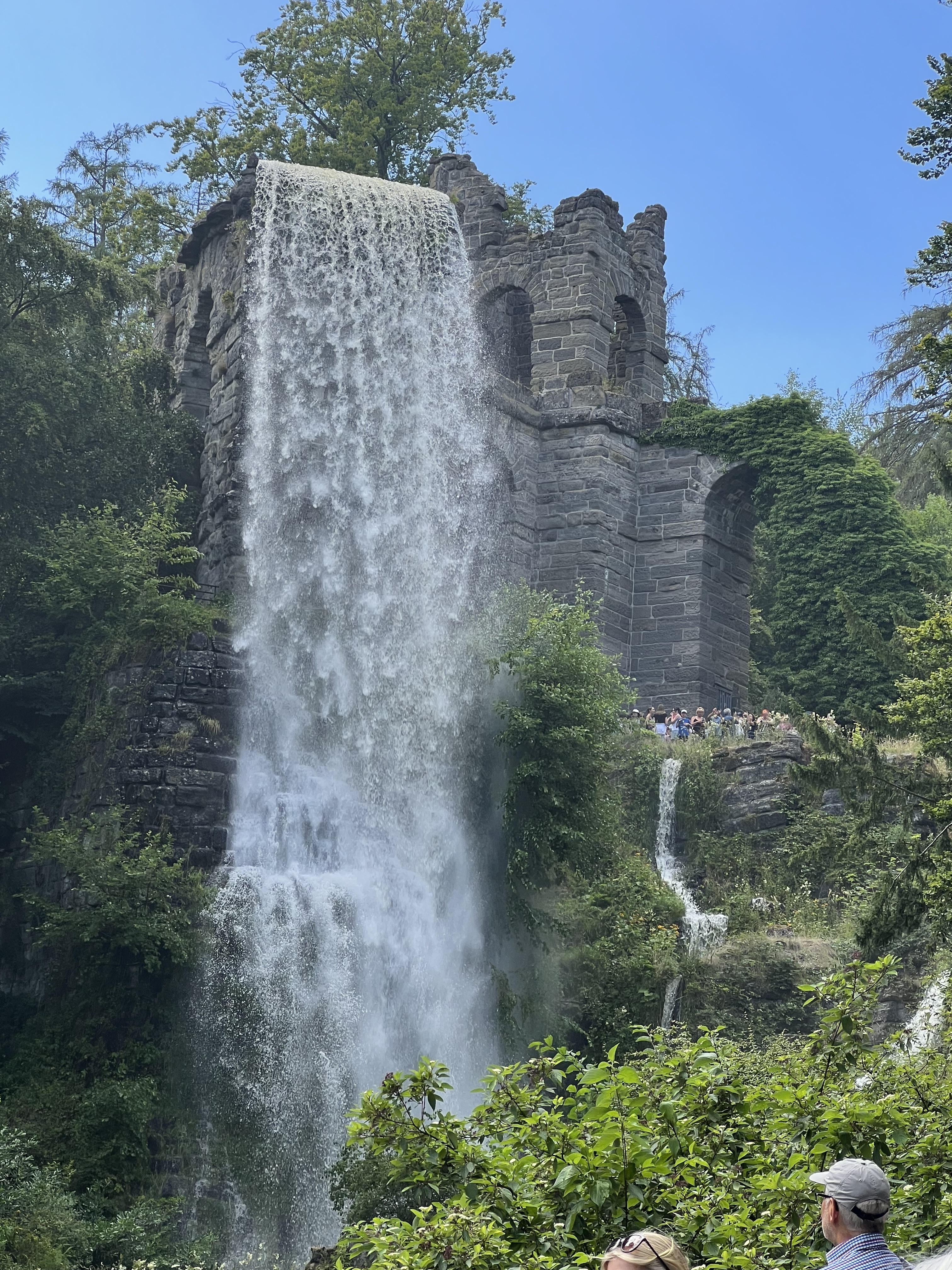
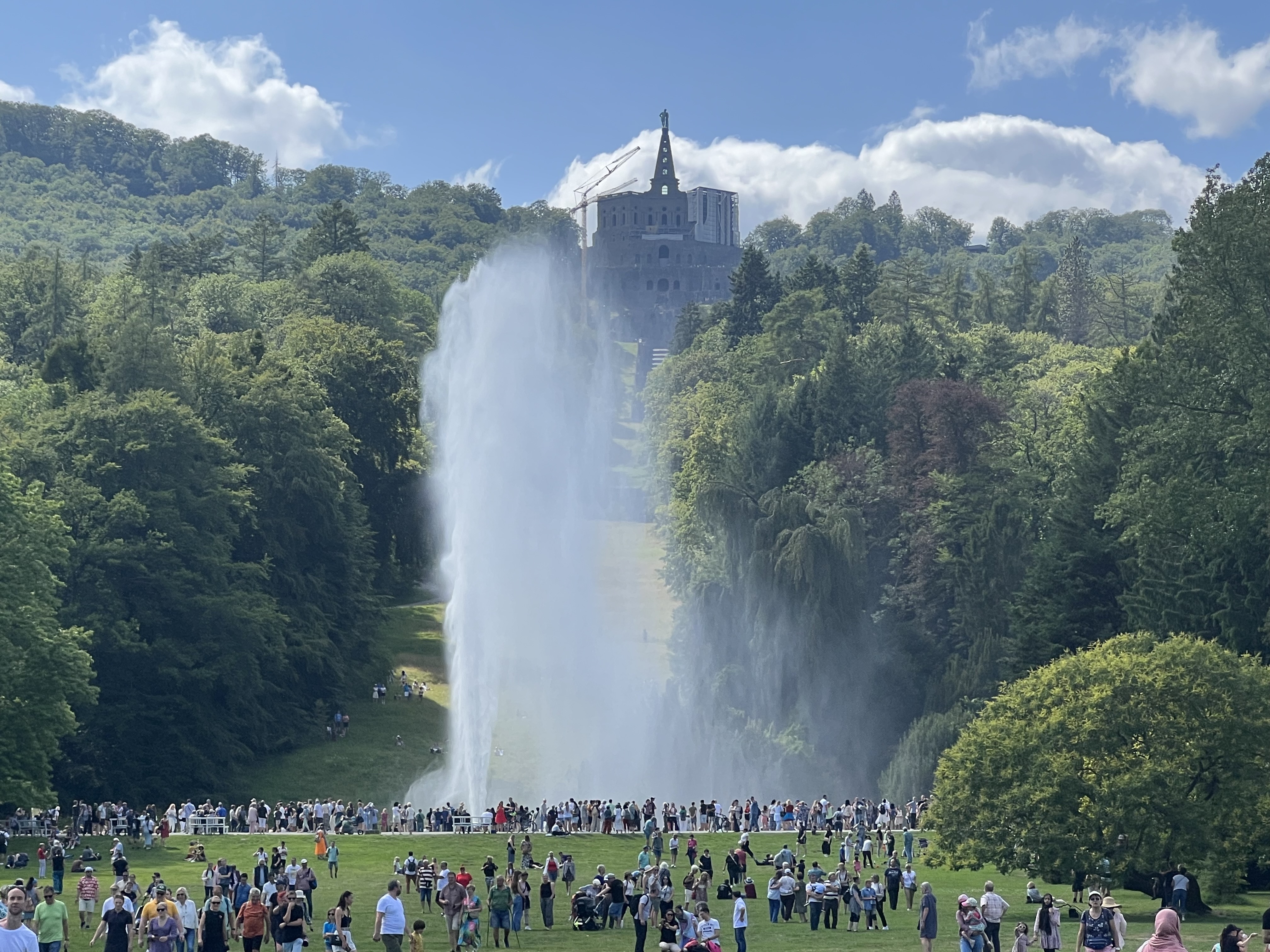
Only twice a week during the summer at a specified time of day, a loud horn signals the start. And then water begins to flow all the way down the mountain finishing its trek by fueling a spectacular 50-metre high fountain in a small lake at the bottom.
Visitors can follow the waterway all the way down just ahead of the rush of water, stopping at various viewing platforms to see the water as it first appears flowing over cliff faces, or rapids or over ancient aqueducts. You can time it just right on your march down the mountain to witness this incredible flow of water.
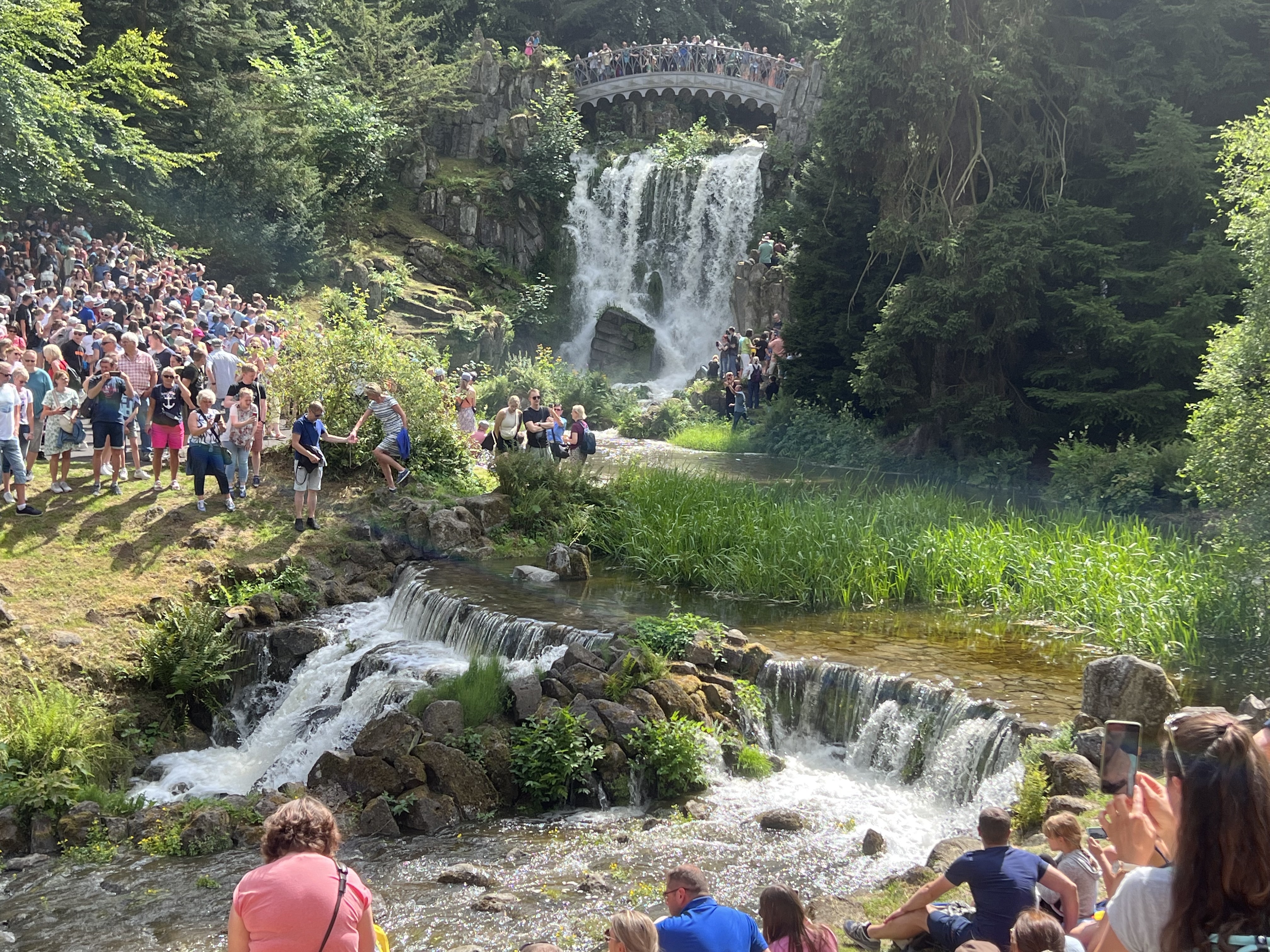
I couldn’t help but relate my experience to the imagery surrounding baptism. Baptism, for many of us, happens near the beginning of our lives. It involves water, the pouring of water over us. Water and baptism are inseparable.
Of course, water flows down the hill. Its trajectory is downward. The life of faith, flowing from our baptism has a similar trajectory. Following Jesus means going down into the valley of our lives. The meaning of faith really hits home when we respond to Jesus’ invitation to “come” and “follow” him, just like Peter did in our Gospel text today when he got out of the boat and into the storm to meet Jesus.[2]
And more often than not, the baptismal life leads to a place where we will be open to Christ’s invitation to follow the water-way and come off the mountain top of our securities and out of our comfort zones.
That is where baptism leads. Follow the water way. Downward mobility is the direction of growing our faith, paradoxically. That is what following Jesus means. This journey down the mountain is the way of love, grace, and acceptance.
In the Baptism liturgy we heard the water references from the bible: when God’s Spirit moved over the waters at creation, when God delivered Noah from the flood, when God led Israel through the sea, when Jesus was baptized by John in the river Jordan.[3] And, at the end of the Gospels when Jesus died on the cross, water flowed from his side.[4] Water dominates the stories of salvation throughout the Bible.
When he encounters people on his earthly journey, and us today, Jesus offers the “living water” that he says he is, an eternal spring that will flow from the hearts of all the faithful.[5]
In the Gospel text for today Jesus encounters his disciples during a storm on Lake Galilee. You get the impression that Peter doesn’t really know what he is getting himself into, when he wants to go to the Lord.
Well, he knows, intellectually. He is a fisherman, after all. He knows the lake. From inside the boat, he sees the waves growing, the winds intensifying. The storm is already unleashing its fury when Peter makes what amounts to his cerebral expression of faith: “If it is you, Lord, command me to come to you on the water.”[6]
But soon Peter will know what he’s getting himself into. “Come,” says Jesus.[7] The difference is that when he leaves the boat, Peter is investing more than just his mind. He is all-in, now.
Peter, in order to know the truth of Jesus, had to follow the way of the water. He had to immerse his entire self—mind, body and spirit. He had to get out of his head and experience a relationship with Jesus. He had to put his whole self on the line, not just what he thinks about Jesus. It’s when he first really notices the waves and is afraid that he knows for himself God’s saving act.
Truth is not an idea. It is a relationship.
Christ Jesus calls us to follow the waterway. Our baptism is neither a private affair occasioned in isolation, nor is it a debate. It is an experience of a relationship. It is conducted among the church—the people of God. We move en masse, together ‘down’ the proverbial mountain and into experiencing God in our daily lives which includes all the challenges of living.
Jesus doesn’t call us to escape the storms. Jesus doesn’t call us to get back into the harbour where it is safe. He calls us to meet the challenges of the world head on, out on the open water. And he calls us to trust in Christ who is present, there, when the storms come. And come they will.
Because especially amid the turbulent storms of life – and that is the message of the Gospel – we experience the love and intimacy of God who created us, lives in us, and invites us into adventures of faith. “Come” says Jesus to you and to me. “Come”, follow the water of life and love that flows on forever.
And Christ Jesus will be right there beside you.
[2] Matthew 14:22-33
[3] Evangelical Lutheran Worship, Pew Edition, Holy Baptism (Evangelical Lutheran Church in America: Augsburg Fortress Press, 2006), p.230
[4] John 19:34
[5] John 4:1-42; 7:38
[6] Matthew 14:28
[7] Matthew 14:29
 Raspberryman